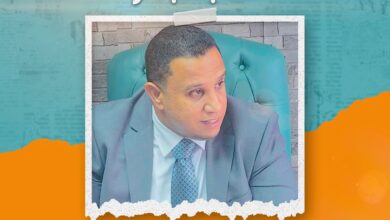

“Egypt Rebuilds the Arab Coalition Anew”

By / Major General Hossam Salama
Recently, President Abdel Fattah El-Sisi surprised us with his visit to Saudi Arabia. Notably, the visit was met with a warm reception, as the Saudi Crown Prince himself came out to welcome the Egyptian president, waiting until the Egyptian plane came to a full stop and its doors opened, allowing President El-Sisi to disembark. The Crown Prince personally drove the car that carried both leaders, without any official escorts or protocols that might have interrupted the personal warmth of the meeting. This reflected the depth of the reception and a clear desire to resolve any previous tensions, closing the door on rumors about the bilateral relations.
The question arises: why was the visit made at this particular time? To answer, one must consider the current developments in the region. Israel continues its plans to displace Palestinians into Sinai and attempts to take control of the remaining areas of the Gaza Strip, aiming to create a humanitarian crisis that pushes Palestinians toward the Egyptian border in search of food and water. Meanwhile, the occupation hinders all peace efforts, seeking to impose a reality that serves its interests, while the United States under former President Trump completely turns a blind eye and provides unlimited support to Israel.
The only Arab leader currently capable of speaking directly with Trump and influencing his positions is the Saudi Crown Prince, who received an official invitation to visit Washington in November. This greatly enhances the importance of Egyptian–Saudi coordination at this stage.
On the other hand, Israel is keen to confront Iran again after the failure of the recent “Twelve Days War” to achieve its goals, whether in toppling the Iranian regime or halting its nuclear program. This renewed confrontation could be more dangerous, given the exhaustion of all political and diplomatic options, which may signal unprecedented military escalation.
Arab leaders, especially after Trump’s recent Middle East visit and his biased positions, realized that rebuilding the Arab coalition has become an urgent necessity. Unity between Cairo and Riyadh in particular provides the region with real political and military strength, as the two countries are the largest Arab states and together form a crucial pillar of regional balance.
Economically, the visit achieved tangible successes. Trade volume between Egypt and Saudi Arabia reached approximately $5.9 billion, an increase of 21% compared to 2024. Saudi Arabia holds a $10 billion deposit in Egypt, which is planned to be converted into investments, potentially easing external debt burdens. Additionally, Saudi investments in Egypt amount to around $34 billion across 800 companies, with plans to increase this figure in the coming period, strengthening economic relations between the two countries.
The most prominent announcement concerns the development of the SUMED pipeline, established in 1974 to connect Ain Sokhna with Port Said for crude oil transportation at a capacity of 60 million tons per year. The new development aims to expand its capacity to transport natural gas and hydrogen gas. This strategic project benefits both the Egyptian and Saudi economies and constitutes a strong move against the “Development Corridor” project linking India via Saudi Arabia to Israel through Jordan for rail and energy export. This step clearly signals the Kingdom’s distancing from any economic normalization with Israel and affirms its commitment to Arab depth.
It is an important visit in every sense, carrying deep political and economic messages, reaffirming the strength of the Egyptian–Saudi relationship, and reviving the idea of a strong Arab coalition that the nation needs today more than ever.
Egypt and Saudi Arabia will always remain the pillars of the Islamic nation and the backbone of its strength.