

The Information and Decision Support Center Reveals the Risks of Electronic Games Using Data from WHO and UNICEF
Al-Gisr – Exclusive
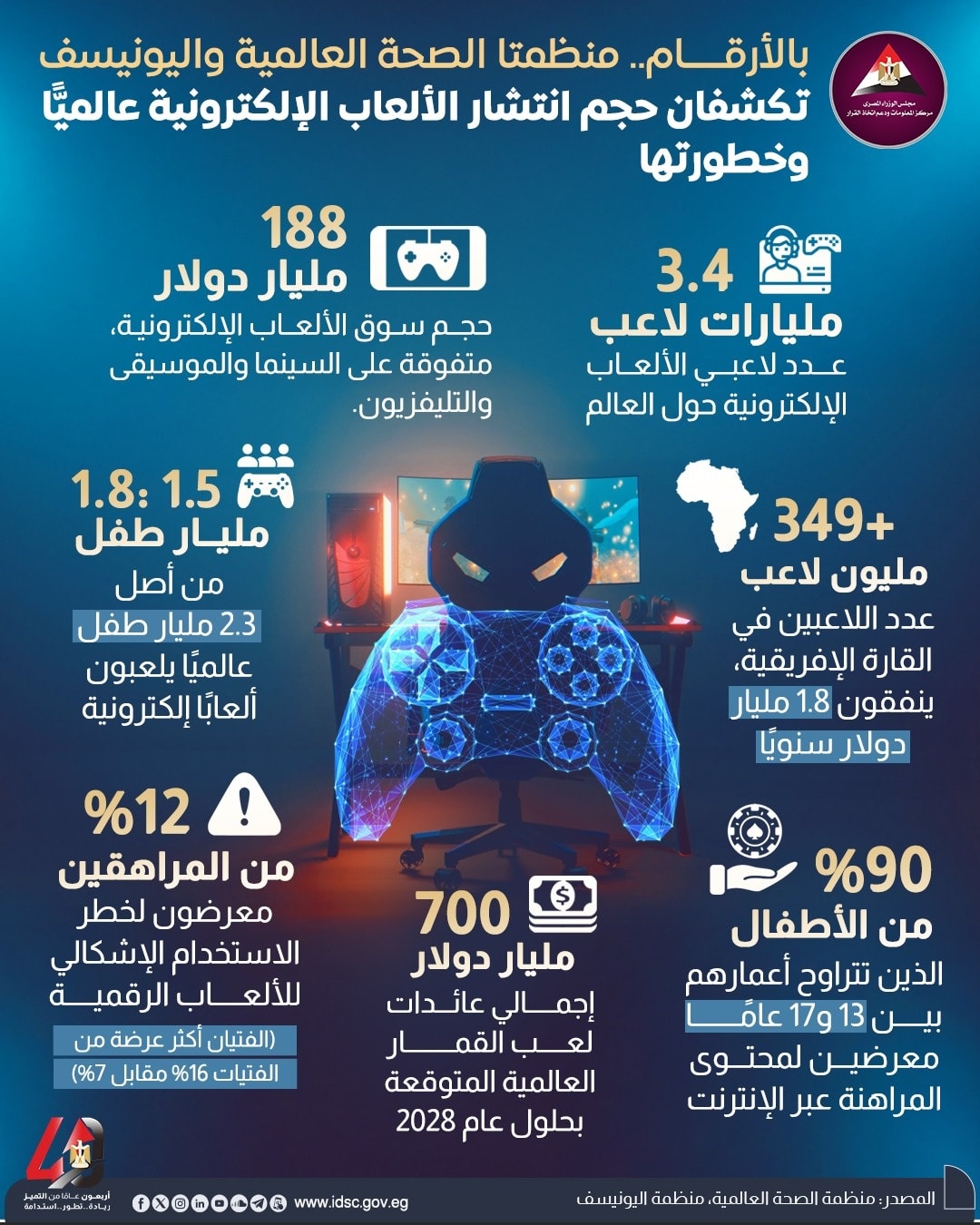
The Information and Decision Support Center (IDSC) has released an infographic highlighting findings from the World Health Organization (WHO) and UNICEF regarding the global spread of electronic games and their growing health and social risks, based on unprecedented numbers that reflect the scale of the phenomenon and its increasing impact on children, adolescents, and societies.
The data revealed that the number of electronic gamers worldwide has reached approximately 3.4 billion players, while the global electronic gaming market exceeds $188 billion annually, surpassing the combined revenues of the film, music, and television industries. This highlights a significant shift in entertainment patterns and digital consumption.
In Africa, the numbers show over 349 million gamers, with annual spending estimated at $1.8 billion, reflecting rapid growth in the African gaming market alongside challenges related to weak regulatory and supervisory frameworks.
Regarding children, the data indicates that between 1.5 and 1.8 billion children out of 2.3 billion worldwide play electronic games, raising increasing concerns about long-term psychological and behavioral effects, especially given the ease of access to inappropriate digital content.
Statistics also show that approximately 90% of adolescents aged 13–17 have been exposed to online gambling or betting content, while 12% are at risk of problematic use of digital games, with boys showing higher exposure rates than girls.
Global gaming revenues are projected to reach around $700 billion by 2028, which underscores the seriousness of the phenomenon if expansion is not accompanied by regulatory frameworks, awareness programs, and child protection mechanisms.
WHO and UNICEF emphasized that these figures clearly indicate that electronic games are no longer merely a form of entertainment but have become a public health and social issue. Addressing this requires multi-level intervention, including legislation, family awareness, the role of educational institutions, and technology platforms, to protect the next generation from potential risks.

